


8 Engineering Features That Make UICO Touch Screens Truly Rugged
Industrial touch screens are expected to perform where consumer devices simply cannot. Whether installed on construction equipment, medical devices, military systems, marine electronics, oil and gas equipment, or factory automation, a rugged touch screen must continue operating in rain, direct sunlight, extreme temperatures, vibration, electrical noise, and while being used with thick work gloves. Not every touch screen is engineered for these conditions. Two displays may appear nearly identical, yet perform dramatically differently in the field. The difference lies in the engineering!
UICO Specializes in Rugged Touch Screen Engineering.
At UICO, we've spent decades developing rugged projected capacitive (PCAP) touch solutions for OEMs that demand dependable performance in the world's toughest environments. These are the eight engineering features that separate a truly rugged touch screen from an ordinary one.

1. Advanced Touch Firmware
The touch controller firmware is the intelligence behind every projected capacitive touch screen.
Advanced firmware distinguishes intentional touches from water droplets, moisture, electrical noise, gloves, and environmental interference. Without properly optimized firmware, even premium hardware can experience false touches, missed inputs, or unreliable performance.
UICO develops application-specific firmware that maintains accurate touch performance under real-world operating conditions while minimizing false activations.
2. Optical Bonding
Optical bonding is one of the most effective ways to improve both display performance and durability. By eliminating the air gap between the touch sensor and LCD, optical bonding delivers several important advantages:
Improved sunlight readability
Increased display contrast
Reduced internal reflections
Better vibration resistance
Greater impact resistance
Reduced moisture intrusion
For demanding outdoor applications, optical bonding can significantly improve long-term reliability.
3. Water Rejection & False Touch Prevention
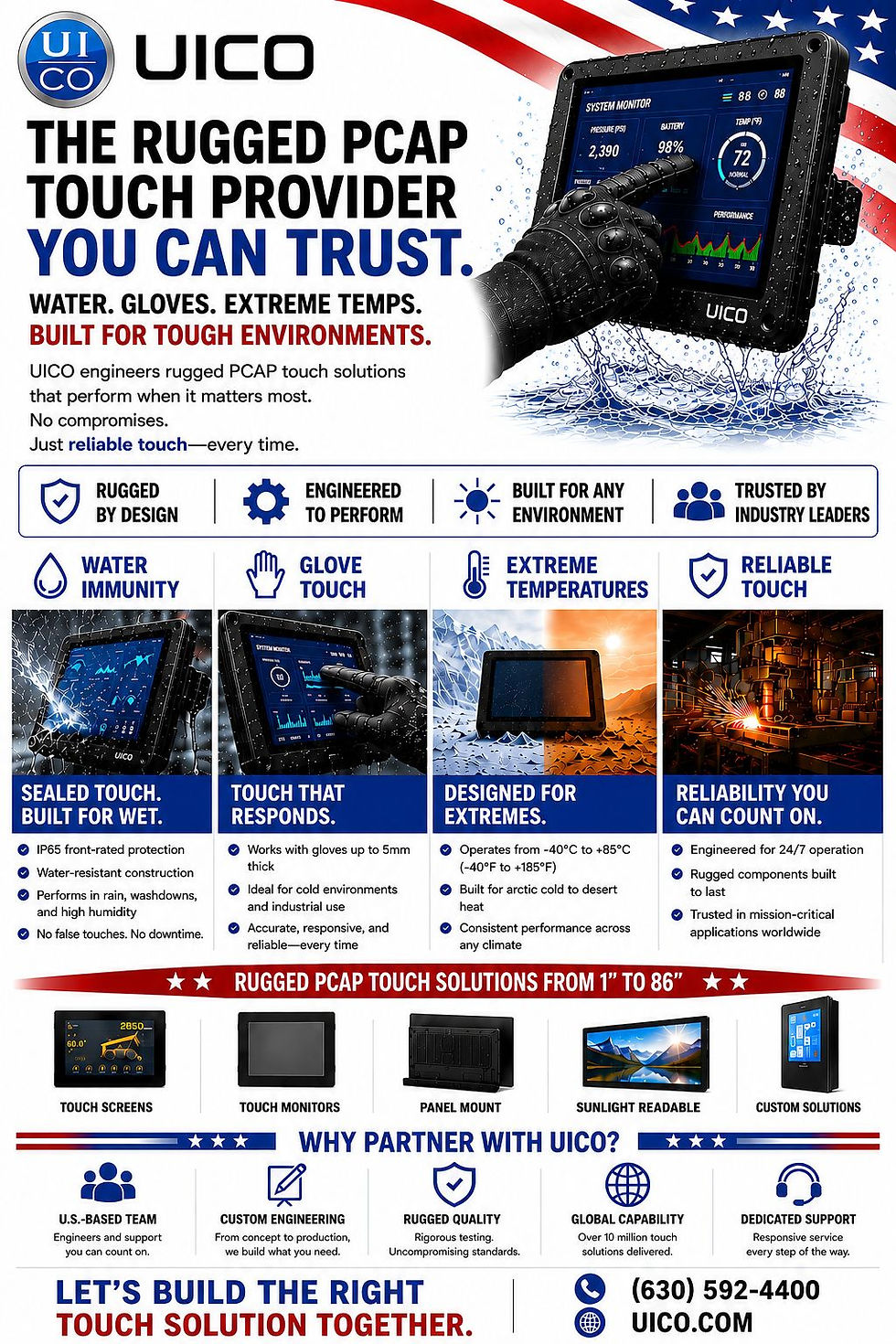
Water remains one of the biggest challenges for projected capacitive technology. Rain, washdowns, condensation, humidity, and accidental spills can cause poorly designed touch systems to register unintended inputs or stop responding altogether. Through advanced sensing algorithms and firmware optimization, UICO touch solutions continue delivering reliable performance in wet operating environments while minimizing false touches.
4. EMI & Electrical Noise Immunity
Factories, heavy equipment, electric motors, generators, and communications systems all generate electromagnetic interference (EMI). Without proper engineering, electrical noise can reduce touch accuracy or create false inputs. UICO addresses EMI challenges through controller optimization, shielding techniques, grounding strategies, and firmware engineered for electrically noisy industrial environments.
5. Sunlight Readability
A rugged touch screen is only useful if operators can clearly see the display. Outdoor applications require much more than high display brightness. True sunlight readability combines optical bonding, anti-glare coatings, anti-reflective treatments, and display optimization to improve visibility while reducing reflections. The result is a display that remains clear and readable, even in bright direct sunlight.
6. Glove Operation
Operators in industrial environments rarely remove their gloves to use equipment.
Manufacturing personnel, utility crews, first responders, military operators, and field technicians all rely on protective gloves throughout the workday. UICO PCAP touch screens support reliable operation through gloves up to 5 mm thick, allowing users to work safely without sacrificing responsiveness or productivity.
7. Extreme Temperature Performance
Industrial equipment operates in environments that range from sub-zero winters to intense summer heat. Touch screens designed for office environments often fail under these conditions.
UICO rugged touch solutions support extreme operating temperatures from -40°C to +85°C, making them suitable for industrial, transportation, marine, military, and outdoor equipment applications.
8. Rugged Mechanical Design
The durability of a rugged touch screen depends on more than electronics. Chemically strengthened cover glass, robust mechanical integration, vibration resistance, impact resistance, and industrial-grade construction all contribute to long-term reliability. Every application presents unique mechanical challenges, making engineering collaboration essential for developing dependable touchscreen solutions.
Why Engineering Matters
Many touchscreen suppliers simply provide hardware. UICO engineers complete touch solutions. From firmware optimization and optical bonding to EMI mitigation, cover glass selection, controller tuning, and mechanical integration, every component is engineered to work together for dependable long-term performance. That's why UICO rugged touch screens continue operating in environments where conventional touch screens often fail.
Frequently Asked Questions
Can PCAP touch screens work with gloves?
Yes. Modern projected capacitive touch screens can be engineered to operate through thick work gloves. UICO supports glove operation up to 5 mm thick.
Can rugged touch screens operate in rain?
Yes. UICO firmware is engineered to reject false touches caused by rain, moisture, and water while maintaining responsive touch performance.
Why is optical bonding important?
Optical bonding improves sunlight readability, increases display durability, reduces internal reflections, and strengthens resistance to vibration and moisture.
What operating temperatures do UICO touch screens support?
UICO rugged touch solutions are engineered for dependable operation from -40°C to +85°C.
What industries use rugged touch screens?
Rugged touch screens are commonly used in industrial automation, construction equipment, transportation, marine electronics, military systems, medical devices, oil and gas equipment, kiosks, agricultural machinery, and other demanding OEM applications.


Comments